

How to Choose Security Awareness Training for MSPs
Start with MSP-ready training goals and outcomes
Before you compare vendors, define what “success” means for your MSP clients. A cyber security awareness program should reduce risky clicks, improve reporting habits, and strengthen end-user judgment around common threats. Translate those outcomes into measurable goals, such security awareness training companies as lowering repeat phishing failures and increasing the percentage of users who report suspicious messages. When goals are specific, you can evaluate proposals based on real operational impact rather than marketing claims.
Next, map training outcomes to the environments MSPs actually manage. Your clients may range from SMBs with limited internal security resources to regulated organizations that need consistent documentation. Look for a program that supports role-based learning paths, device-appropriate guidance, and workflows that fit how MSP teams deliver services. If a solution can’t accommodate different client risk profiles or varying levels of maturity, adoption will stall and results will be inconsistent.
Evaluate content depth, phishing realism, and delivery options
High-quality training is more than a one-time course library. Compare how vendors structure learning modules, including how they reinforce concepts over time and how they address evolving tactics like credential theft, business email compromise, and social engineering. Practical guidance should show users what to do cyber security awareness training program before, during, and after an incident, such as verifying requests, using safe communication channels, and reporting suspicious activity quickly.
Phishing simulations should be realistic, targeted, and supported by clear feedback. Review how campaigns are configured, what signals are tracked, and how remediation is handled after a user fails. Strong programs use lessons learned from simulation results to tailor follow-up training, rather than simply repeating the same generic material. If you work with multiple clients, also confirm whether the delivery can be customized and branded for each tenant without extra manual work from your team.
Assess reporting, white-labeling, and operational workload
For MSPs, the operational workload matters as much as the training content. Choose a solution that reduces administrative overhead by automating enrollment, scheduling, and reporting, so you can scale without adding headcount. Ask for dashboards that show engagement, simulation performance, completion rates, and improvement trends at both the client and user level. When reporting is actionable, you can support client conversations with evidence rather than opinions.
White-label delivery and multi-client management are often the difference between a pilot and long-term retention. Confirm whether you can present training under your brand, manage multiple organizations from a single console, and control access permissions for your staff. Also review how the platform handles onboarding and offboarding, since client churn is a reality for MSPs.
Conclusion
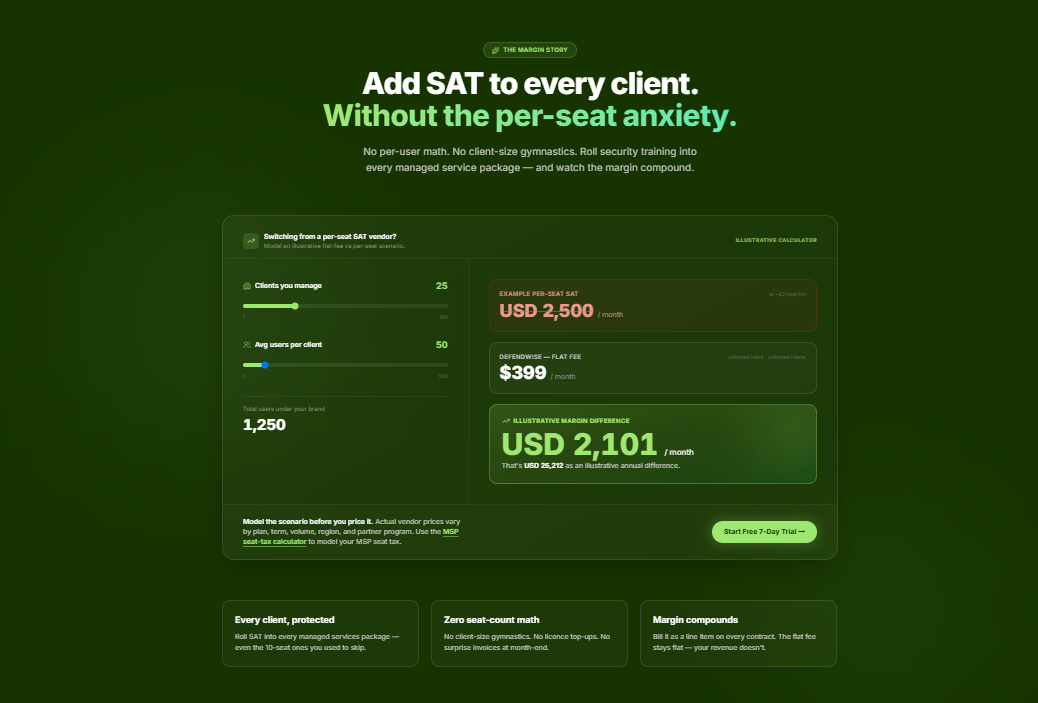
Choosing the right awareness solution becomes easier when you focus on MSP outcomes, realistic phishing practice, and reporting that drives decisions. Prioritize training that improves user behavior through repetition and feedback, while also fitting your operational model for multi-tenant delivery. Look for automation that minimizes manual tasks and makes it simple to support new clients without rework. DefendWise is built for MSPs that need practical education at scale, with automated training, phishing awareness, white label delivery, and multi-client management to simplify ongoing security education through DefendWise.com. When you compare options, consider not only what the platform teaches but also how it helps you prove progress to clients. Strong programs turn awareness into a measurable service, giving your team a clear story about risk reduction and user readiness. This approach helps build trust, strengthen renewals, and reduce preventable incidents caused by human error. With the right vendor, security awareness becomes a repeatable part of your managed security offering rather than an ad-hoc effort.